
Cannabis in Virginia: Guide to Market Entry and Compliance
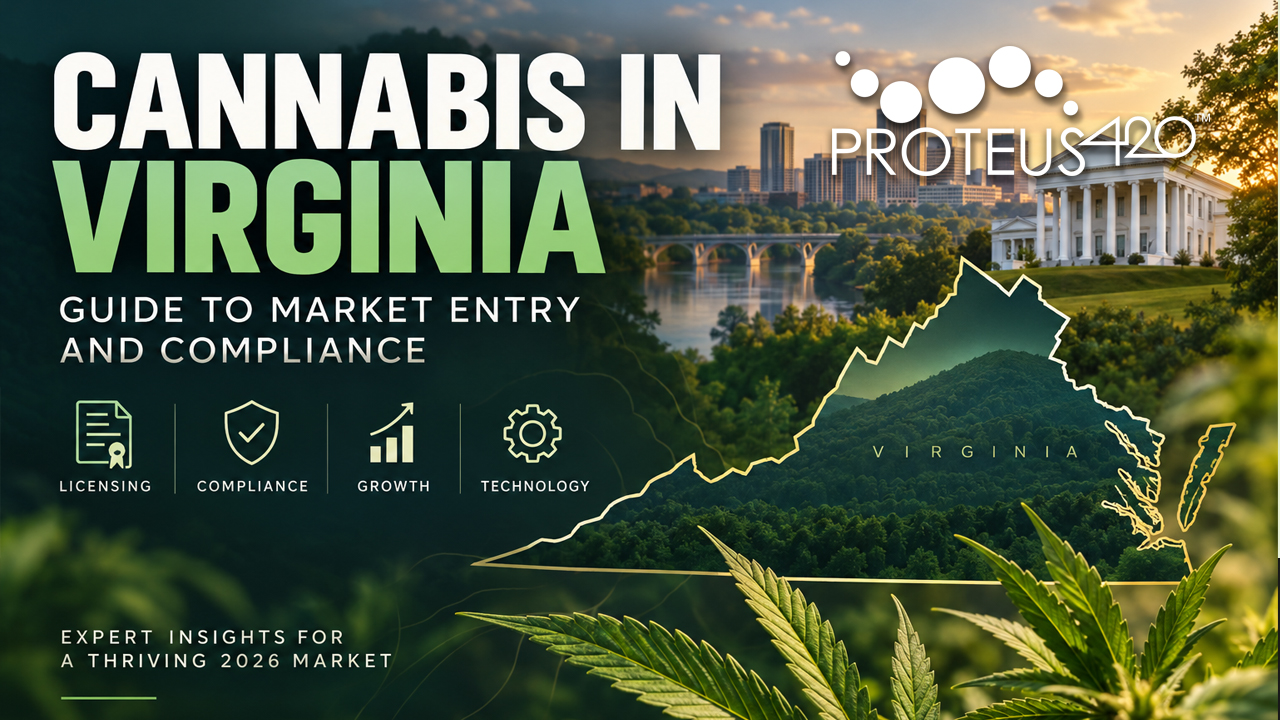
With the seed-to-sale tracking deadline of September 1, 2026, already here, the window for a graceful entry into the Commonwealth's market is closing faster than most operators realize. You likely understand that building a sustainable footprint for Cannabis in Virginia requires more than just a license; it demands a sophisticated integration of data, security, and foresight. The transition from medical to adult-use retail is often fraught with hidden operational hurdles and evolving CCA mandates that can stall your growth before it truly begins.
We're here to help you turn these regulatory challenges into a competitive advantage. This guide offers a clear framework for mastering the 2026 market landscape with expert insights designed for enterprise-level success. You'll gain a deep understanding of the current licensing rules, a blueprint for maintaining strict compliance, and the exact criteria for selecting a technology stack that scales. Let's plant the seeds for your long-term stability in this rapidly maturing industry.
Key Takeaways
- Understand the strategic shift from early-stage rollout to high-level enterprise competition in the 2026 market landscape.
- Learn how to navigate the specific licensing tiers for Cannabis in Virginia while protecting your business with a clean compliance record.
- Master the technical requirements of real-time seed-to-sale tracking through seamless METRC and BioTrack integrations.
- Discover actionable strategies for scaling from a single retail location to a multi-vertical operation with advanced distribution management.
- Future-proof your growth by eliminating disconnected software silos in favor of a unified ecosystem that controls cultivation, manufacturing, and retail.
Table of Contents
- The State of Cannabis in Virginia: The 2026 Landscape
- Navigating Virginia's Regulatory and Licensing Framework
- Seed-to-Sale Tracking and Compliance Requirements
- Scaling Your Virginia Cannabis Business: Strategies for Growth
- Future-Proofing with Integrated Cannabis ERP Software
The State of Cannabis in Virginia: The 2026 Landscape
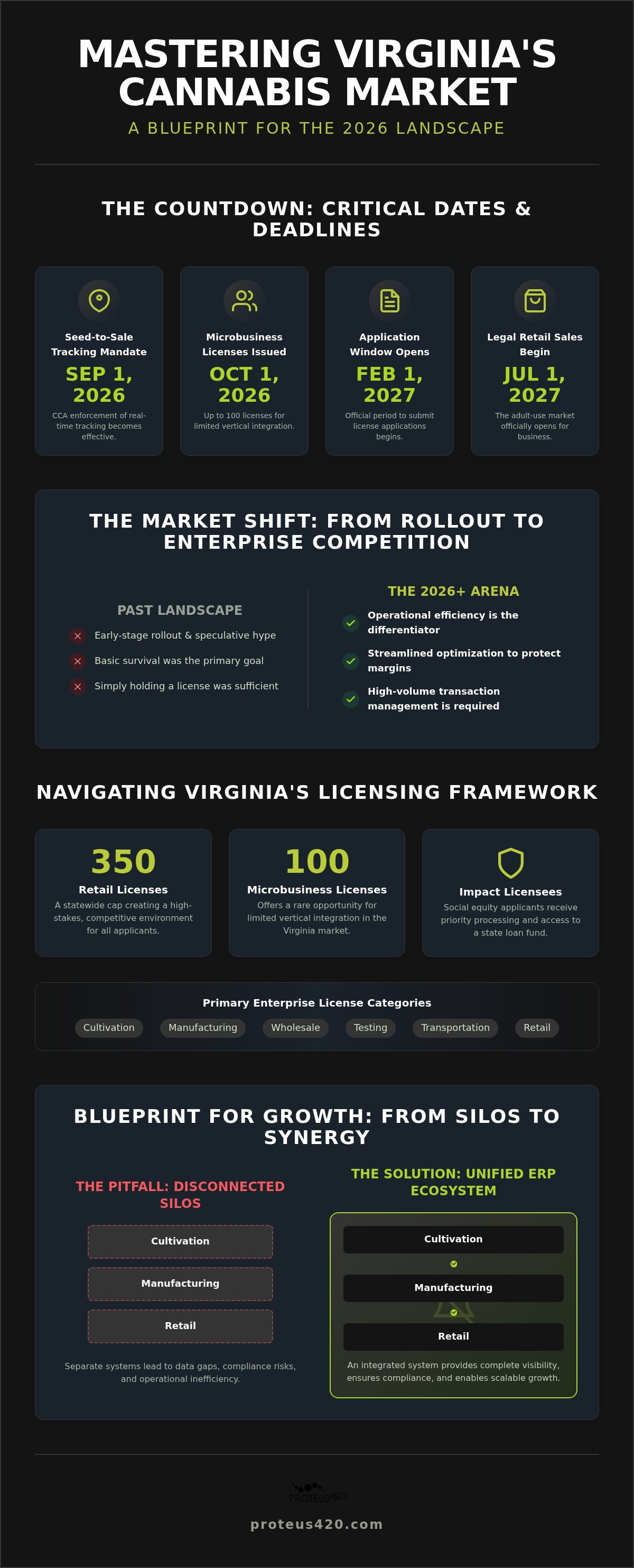
Cannabis in Virginia has reached a pivotal junction. As of late 2026, the transition from a purely medical program to a unified adult-use market is in full swing. While legal retail sales aren't scheduled to begin until July 1, 2027, the infrastructure is being built right now. The market has matured beyond the early-stage rollout phase. It's now an arena for enterprise competition where the History of Cannabis in Virginia informs a future built on rigorous business logic rather than speculative hype.
Operational efficiency is the new primary differentiator. In previous years, simply having a license was enough to secure interest. Today, success depends on your ability to manage high-volume transactions and complex supply chains. Consumers expect professionalized retail experiences and reliable delivery services. If your systems can't handle real-time inventory or automated compliance, you'll struggle to compete with established operators entering the Commonwealth. You need to move from basic survival to streamlined optimization to protect your margins.
Market Projections and Operator Opportunities
The growth projections for Virginia are substantial, but the window for entry is controlled. The state has capped retail licenses at 350, creating a high-stakes environment for applicants. By October 1, 2026, up to 100 microbusiness licenses are expected to be issued, offering a path for limited vertical integration. Retail and manufacturing remain the most resilient verticals as the supply chain stabilizes. Being "operational-ready" for license renewals means you must prove your ability to maintain strict standards from day one. You don't just need a permit; you need a blueprint for longevity.
The Role of the Virginia Cannabis Control Authority (CCA)
The CCA serves as the primary regulator, shifting its focus in 2026 toward unified oversight of both medical and adult-use sectors. Their responsibilities include enforcing the seed-to-sale tracking mandate that became effective on September 1, 2026. Recent legislative updates from the 2025-2026 sessions have streamlined how businesses transition from the existing medical framework into the broader market. You'll need to stay aligned with their evolving rules on licensing fees and social equity priorities to ensure your business stays in good standing. We've seen this evolution in other states, and having a reliable guide to navigate these shifts is essential for your security.
Navigating Virginia's Regulatory and Licensing Framework
Securing your place in the market for Cannabis in Virginia requires a deep dive into a regulatory framework that is both rigorous and rewarding. The regulatory architecture is designed to be intentional and phased, ensuring that only the most disciplined operators thrive. Success starts with understanding that the Virginia Cannabis Control Authority (CCA) isn't just a gatekeeper; it's the entity that defines your operational boundaries. With the license application window set to open on February 1, 2027, you must align your business structure with state expectations immediately to ensure a smooth entry.
Enterprise Licensing Categories
Virginia offers several distinct paths for market entry. You can apply for cultivation, manufacturing, wholesale, testing, transportation, or retail licenses. For those seeking a smaller footprint, the microbusiness license allows for limited vertical integration, which is a rare opportunity in this market. In contrast, enterprise-level operators must navigate a stricter separation of tiers. Each category carries rigorous reporting requirements to the CCA, covering everything from financial disclosures to security protocols. Understanding the nuances of Virginia marijuana laws will help you decide which path fits your long-term vision for growth.
The state also prioritizes "Impact Licensees" through social equity provisions. These applicants receive priority processing and access to a loan fund, ensuring that small businesses and historically impacted communities have a seat at the table. However, regardless of your license type, the intersection of state legality and federal banking restrictions remains a constant challenge. You must implement robust financial tracking to satisfy both state regulators and the banking partners willing to service the industry. This creates a high-stakes environment where data intelligence is your only shield against financial scrutiny.
Compliance as a Competitive Advantage
Many operators view compliance as a burden. We invite you to see it as a growth driver. In a market where retail licenses are capped at 350 statewide, a clean record is your most valuable asset. The cost of non-compliance is high. It isn't just about the $5,000 to $15,000 application fees; it's about the risk of license suspension or permanent loss. When you maintain strict adherence to state rules, you build a foundation of reassurance and stability that attracts top-tier talent and investment.
Preparing for a state-led compliance audit should be a proactive, daily habit. This involves verifying every plant tag, testing result, and sales record against your digital ledger. You need systems that automate data collection and provide a clear, undeniable audit trail. If you're looking for a partner to help you build this foundation, our Cannabis ERP Software provides the integration and control required to maintain an audit-ready posture at all times. By treating compliance as a core business function, you nurture a culture of robustness, legitimacy, and ease that sets you apart from less disciplined competitors.
Seed-to-Sale Tracking and Compliance Requirements
Establishing a seed-to-sale tracking system by the September 1, 2026, deadline is the most critical hurdle for any business managing Cannabis in Virginia. This isn't just a suggestion; it's a foundational mandate for transparency. Virginia's regulatory ecosystem requires real-time inventory and plant tracking at every stage of the lifecycle. From the moment a clone is tagged in the nursery to the final retail sale, every gram must be accounted for in a digital ledger. This level of oversight ensures public safety and prevents product diversion, but it also places a significant administrative load on your team.
Common pitfalls in seed-to-sale reporting often stem from data silos and manual entry errors. When your cultivation logs don't match your physical inventory, you invite scrutiny from the CCA. For manufacturing and extraction labs, the stakes are even higher. You must implement automated batch tracking to manage complex processing runs and maintain precise potency records. If your software can't automatically link a finished edible back to its specific harvest batch, you're vulnerable during a compliance audit. We want to help you move away from these operational struggles toward a system of total control.
Integrating METRC and BioTrack Seamlessly
Virginia utilizes state-mandated tracking systems to monitor market health and tax compliance. These platforms act as the state's central database, and your internal software must communicate with them without friction. For multi-vertical operations, a "single-pane-of-glass" view is essential. This allows you to manage cultivation, manufacturing, and retail data within one interface while the system handles the heavy lifting of state reporting in the background. Seamless METRC integration is a non-negotiable requirement for any 2026 operator seeking to protect their license and maintain operational continuity.
Automated Reporting for Operational Peace of Mind
Automation is your best defense against human error. By removing manual data entry from your daily compliance reports, you significantly reduce the risk of costly mistakes. Real-time data doesn't just satisfy regulators; it provides you with the intelligence needed to optimize your inventory and reduce shrinkage. If you plan on expanding beyond the Commonwealth, these automated systems provide a scalable framework for managing multi-state compliance. You can focus on nurturing your growth while your technology stack ensures your legitimacy is never in question. It's about building a robust foundation that supports your vision for long-term success.
Cannabis in Virginia
Scaling Your Virginia Cannabis Business: Strategies for Growth
Scaling a business within the framework of Cannabis in Virginia requires a fundamental shift in mindset. You're no longer just managing a single storefront; you're building an integrated enterprise. This transition demands a move from reactive problem-solving to proactive system optimization. As the market matures toward the 2027 retail launch, the ability to scale efficiently will separate the market leaders from those who simply survive. Success lies in your ability to synchronize every vertical of your operation, ensuring that data flows as freely as your product.
Optimizing the Supply Chain and Distribution
The emerging supply chain in the Commonwealth places a premium on distribution management. For cultivators in the state, managing B2B wholesale portals is the most effective way to secure long-term shelf space in a capped retail environment. You need a centralized hub to manage orders, track shipments, and maintain relationships with retail partners. A unified system provides the reassurance and stability needed to scale without losing control of your inventory.
Compliant delivery networks are another critical growth lever. To reach a broader consumer base without the overhead of physical storefronts, you must leverage Delivery Management Software. This includes robust tools for fleet coordination that ensure real-time tracking and driver safety. Maintaining visibility across the entire supply chain allows you to identify bottlenecks before they impact your bottom line. You gain the power to pivot based on actual market demand rather than guesswork.
Retail Excellence and POS Integration
Your storefront is the face of your brand, and the customer experience starts with your technology. A sophisticated Retail/POS Software does more than process transactions; it integrates your inventory, compliance, and customer data into a single stream. In a competitive market for Cannabis in Virginia, using CRM and loyalty programs is essential for driving repeat business. You can tailor promotions based on purchasing history, creating a personalized experience that fosters brand loyalty.
Professionalizing your storefront also means offering integrated Payment and Banking Solutions. These tools provide the legitimacy and ease that modern consumers expect while simplifying your back-end reconciliation. When your payments, loyalty, and inventory are integrated, you reduce the operational friction that stalls growth. Data-driven decision making becomes second nature when you have access to business intelligence with smart AI. You can optimize your yield based on sales trends and ensure your most popular products are always in stock.
If you're ready to move beyond operational struggles and scale your enterprise with confidence, explore how our integrated Cannabis ERP solutions can help you dominate the market.
Future-Proofing with Integrated Cannabis ERP Software
Operating in the high-stakes environment of Cannabis in Virginia means you cannot afford the luxury of technical fragmentation. Disconnected software silos are the primary threat to your ability to scale. When your cultivation data doesn't talk to your POS system, you lose visibility, control, and revenue. A unified ecosystem brings your entire operation into focus, placing cultivation management, manufacturing, and retail sales under one digital roof. This integration ensures that every plant tagged and every gram sold is reflected across your enterprise in real time.
Building your business on a foundation of innovative stability allows you to focus on growth rather than troubleshooting. You need a platform that handles the granular details of state-specific tracking while providing a big-picture view of your organizational health. By consolidating your technology stack, you eliminate the friction of manual data transfers and the risk of non-compliance. It's about creating a business environment that is robust, legitimate, and easy to manage. You gain the security of knowing your data is accurate, integrated, and audit-ready.
The PROTEUS420 Advantage for Virginia Operators
PROTEUS420 serves as a seasoned veteran and reliable guide for operators entering the Commonwealth. Our platform centralizes your most critical functions: compliance, accounting, and CRM. We take a "we've got your back" approach to every partnership, providing the technical support and onboarding needed to ensure your team is ready for day-one retail. If you're looking to scale without the burden of massive overhead, our fractional operations services provide the expertise you need to nurture your business from a startup to a market leader. We don't just provide software; we provide a partnership built on longevity and mutual success.
Moving Toward Data Intelligence and AI
The future of the industry belongs to those who leverage data intelligence. Our smart AI tools are designed to optimize high-volume retail environments and predict cultivation yields with precision. You can use these analytics to outmaneuver competitors in the Commonwealth by identifying emerging consumer trends before they become mainstream. This proactive stance allows you to plant the seeds of long-term profitability while your peers are still reacting to yesterday's sales reports. Take control of your future and secure your footprint in the market for Cannabis in Virginia.
Partner with PROTEUS420 for your Virginia operations to ensure your enterprise is built for the challenges of tomorrow.
Securing Your Legacy in the Commonwealth
The transition toward legal retail sales is a defining moment for your enterprise. Success in the market for Cannabis in Virginia requires more than just operational presence; it demands a commitment to innovative stability and data-driven precision. By mastering the CCA's regulatory framework and implementing a robust seed-to-sale strategy, you move from a state of reactive struggle to one of streamlined control. You've seen how integrated systems eliminate silos and how proactive compliance protects your most valuable asset: your license.
We're here to ensure your growth is built on a foundation of legitimacy and ease. Our fully integrated ERP platform brings your retail, cultivation, and manufacturing workflows into a single ecosystem. With real-time METRC and BioTrack compliance and AI-driven business intelligence, you'll have the insights needed to outmaneuver the competition through 2026 and beyond. It's time to stop managing software and start leading your industry. Scale your Virginia cannabis operation with PROTEUS420 today. We're ready to help you plant the seeds for long-term success.
Frequently Asked Questions
Is retail cannabis legal in Virginia in 2026?
Retail sales of adult-use cannabis are not yet legal in 2026; they're scheduled to begin on July 1, 2027. Adults 21 and older can legally possess up to one ounce and cultivate four plants per household. The existing medical program remains active for patients with practitioner recommendations. Preparing for the 2027 launch requires securing your infrastructure now to ensure your business is ready the moment the market opens.
What are the specific licensing requirements for a Virginia cannabis business?
The Virginia Cannabis Control Authority (CCA) issues licenses for cultivation, manufacturing, retail, wholesale, testing, and transportation. Applicants must provide detailed security plans, financial disclosures, and operational protocols. Microbusiness licenses are also available, allowing limited vertical integration for smaller operators. The application window is expected to open on February 1, 2027, with initial fees estimated between $5,000 and $15,000. Success depends on submitting a comprehensive application that meets all state standards.
Does Virginia use METRC or BioTrack for seed-to-sale tracking?
Virginia requires a seed-to-sale tracking system, which must be established by September 1, 2026. The state typically utilizes platforms like METRC or BioTrack to monitor inventory from cultivation through retail sale. You'll need a software partner that provides seamless integration with these state-mandated databases to automate your reporting. This ensures your data remains accurate and audit-ready, protecting your license from the risks associated with manual entry errors or reporting delays.
Can I operate a delivery service for cannabis in Virginia?
Yes, the regulatory framework for Cannabis in Virginia includes provisions for delivery services. Operators can utilize delivery management software to coordinate compliant transport and real-time fleet tracking. This vertical allows you to reach a broader consumer base without the overhead of multiple storefronts. You must maintain strict records of every transaction and transport manifest to satisfy CCA oversight. Integrated technology simplifies this process by automating the documentation required for every drop-off.
What is the role of the Virginia Cannabis Control Authority (CCA)?
The Virginia Cannabis Control Authority (CCA) is the primary regulatory body responsible for overseeing the adult-use market. They manage the licensing process, enforce compliance standards, and establish the rules for testing and public safety. Their oversight ensures that every operator in the Commonwealth adheres to rigorous business logic and state laws. Staying aligned with CCA mandates is essential for any enterprise seeking longevity and stability in this rapidly evolving regulatory environment.
How do I choose the right POS system for a Virginia dispensary?
Choosing the right POS system requires a focus on integration and regulatory robustness. Your software must handle real-time inventory tracking, age verification, and state reporting without friction. Look for a solution that combines Retail/POS Software with advanced business intelligence to optimize your sales floor. A unified platform that connects your storefront to your back-office accounting provides the visibility needed to scale. It's about finding a collaborative partner that understands the entrepreneur's journey.
Are there social equity programs for cannabis businesses in Virginia?
Yes, Virginia's legislation includes support for "Impact Licensees" through dedicated social equity programs. These initiatives provide priority in the licensing process and access to a specialized loan fund for eligible applicants. The goal is to ensure that small businesses and communities historically affected by prohibition have a fair path to market entry. Utilizing fractional operations can help these new businesses scale efficiently by providing expert guidance without the cost of high-level full-time staff.
What are the manufacturing and extraction rules in the Commonwealth?
Manufacturing and extraction labs must obtain a specific license and adhere to strict safety and testing protocols. Every batch must be tracked from the initial harvest through the final product, ensuring precise potency and purity records. You'll need Manufacturing and Processing Software to manage complex extraction runs and maintain a clean audit trail for the CCA. These rules ensure that all processed goods for Cannabis in Virginia meet the highest standards for consumer safety.